Transporting a golf cart from China requires more than booking a vessel and waiting for delivery. The process involves careful preparation, accurate measurements, battery handling, secure loading, and reliable communication. Before shipping, record the cart’s length, width, height, weight, model, and battery type. Remove loose accessories, secure the steering mechanism, and protect exposed surfaces with foam and stretch film. A wooden crate or reinforced frame can reduce damage from movement, moisture, and repeated handling. Do not rely on appearance alone.
Dr. Chris Caplice, a logistics expert and former executive director at MIT’s Center for Transportation and Logistics, often emphasizes, “A shipment is only as strong as its weakest handoff.” That principle matters when asking how to transport a golf cart safely from China. The cart may pass through a factory, warehouse, port, vessel, customs facility, and final delivery truck. Each transfer creates another opportunity for shifting or impact. Use a qualified freight forwarder, confirm export documents, and follow carrier rules for batteries and vehicle cargo. Take detailed photographs before loading. They provide useful evidence if something looks different later.
This guide explains how to transport a golf cart safely through practical steps, from factory inspection to final delivery. It also acknowledges an uncomfortable truth: even careful planning cannot remove every risk. A loose strap, missing measurement, or rushed inspection can change the outcome. Small details matter. Always verify current carrier instructions before shipment.
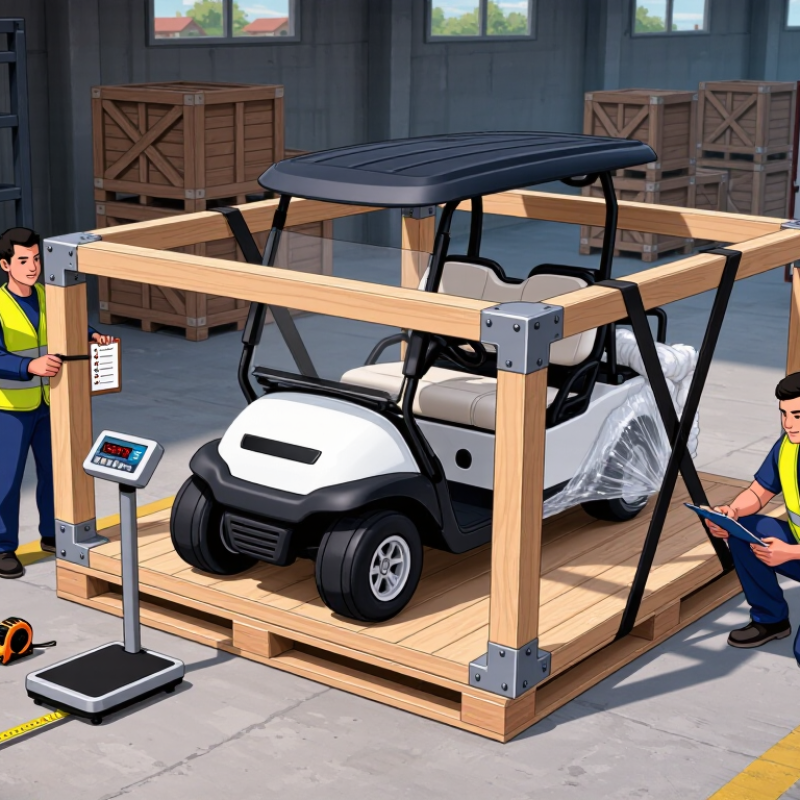
How to Transport a Golf Cart Safely from China?
Before requesting a shipping quote, record the golf cart’s exact length, width, and height. Measure it with the roof, windshield, mirrors, seats, and steering wheel installed. A few extra centimeters can affect crate design and container placement. Do not trust a rounded figure. Ask the supplier for recent measurement photos and a packing list.
Weight needs the same attention. Confirm the cart’s unloaded weight, battery weight, charger weight, and final packed weight. The wooden crate, ramps, and spare parts may add several hundred kilograms. A platform scale ticket is more reliable than a catalog estimate. One common mistake is using the vehicle’s curb weight for freight booking. That number can exclude accessories and packaging.
Battery details also determine handling requirements. Identify whether the cart uses flooded lead-acid, AGM, or lithium-ion batteries. Record the voltage, quantity, capacity, removable status, and installation position. Ask for the battery specification sheet and safety documentation when required by the carrier. Lithium batteries may need specific packaging, labeling, and transport approval. Lead-acid batteries must be secured against leakage and movement. The charger should be packed separately when practical. A final inspection should compare the declared details with the actual cart, because small inaccuracies can cause delays, remeasurement fees, or unsafe loading decisions.
How to Transport a Golf Cart Safely from China?
Select Containers Using Standard 20-Foot Dimensions: 5.9 × 2.35 × 2.39 m
A standard 20-foot container offers nominal internal dimensions of 5.9 × 2.35 × 2.39 meters. These measurements provide a useful planning reference. They are not guaranteed loading space. Door openings, corner posts, floor rails, and container tolerances reduce usable clearance.
Measure the golf cart before booking transport. Record its total length, width, height, tire width, and roof clearance. Lower or remove the roof only when the manufacturer’s instructions permit it. Fold the windshield securely. Keep steering controls protected. A cart measuring 2.8 meters long may fit comfortably, but side clearance still matters during loading.
Place the cart centrally inside the container. Use certified wheel chocks and rated tie-down straps. Attach restraints to strong frame points, never fragile body panels. Leave safe clearance around the roof and doors. The cart must not move when pushed by hand. Check the parking brake, then add mechanical blocking because brakes can loosen during ocean movement.
Battery handling requires extra care. Follow the battery supplier’s transport instructions and the carrier’s documentation requirements. Disconnecting terminals may help prevent accidental activation, but incorrect handling can create damage. This is where rushed loading often fails. Inspect for leaks, loose cables, and exposed terminals before sealing the container. Photograph the dimensions, restraints, and container number for a reliable shipping record.
| Data Dimension | Reference Value | Practical Meaning for Golf Cart Shipping | Safety or Planning Check |
|---|---|---|---|
| Standard 20-Foot Dry Container Reference | |||
| External length | Approximately 6.06 m | The overall container footprint used for vessel, terminal, and inland transport planning. | Confirm chassis, trailer, and route restrictions before arranging domestic delivery. |
| External width | Approximately 2.44 m | Defines the outside transport envelope when the loaded container moves by road. | Check local road limits, escort requirements, and access to the pickup or delivery site. |
| External height | Approximately 2.59 m | Important for bridges, warehouse doors, loading bays, and truck clearances. | Measure the complete loaded vehicle height, including the container chassis. |
| Usable internal length | Approximately 5.90 m | Available floor length for the golf cart, wheel chocks, blocking, and tie-down space. | Use the actual internal measurement supplied by the container operator before loading. |
| Usable internal width | Approximately 2.35 m | Available width between the side walls; mirrors, steering wheels, and accessories must fit within this space. | Measure the golf cart at its widest point, not only across the tires. |
| Usable internal height | Approximately 2.39 m | Available vertical clearance for the vehicle, roof, windshield, protective packaging, and lifting equipment. | Allow working clearance above the vehicle; do not rely on a nominal zero-clearance fit. |
| Door opening | Approximately 2.34 m wide × 2.28 m high | The golf cart must pass through the door, which is normally smaller than the internal container space. | Measure the cart width with mirrors and the full height with the roof installed. |
| Typical maximum gross container mass | Commonly up to 30,480 kg; verify the container plate and route limit | Includes the golf cart, batteries, packaging, accessories, blocking, and container tare weight. | Use the lower limit when the shipping line, road authority, terminal, or chassis has a stricter limit. |
| Golf Cart Fit and Loading Data | |||
| Recommended measurement set | Length × maximum width × total height × gross weight | These four measurements determine whether the cart can enter, be secured, and remain within container limits. | Measure after installing the roof, windshield, seats, mirrors, bumpers, and any rear cargo accessories. |
| Length allowance | Cart length should be shorter than 5.90 m, with additional working space | Extra space is needed for wheel chocks, timber blocking, straps, and safe access during loading. | A tight length fit may make securement impossible even when the cart technically fits. |
| Width allowance | Cart width should be below the approximately 2.34 m door opening | The door opening, rather than the 2.35 m internal width, is usually the limiting dimension. | Remove or fold detachable mirrors and accessories only when permitted and properly protected. |
| Height allowance | Cart height should be below the approximately 2.28 m door opening | A cart may fit inside the container but fail to pass through the door if the roof or windshield is too high. | Never force the vehicle through the door; select a suitable container or use an approved alternative loading method. |
| Floor loading | Distribute tire loads over sound floor areas | Concentrated loads can damage flooring or allow the cart to shift during handling. | Use suitable timber or load-spreading materials under the tires when required by the loading plan. |
| Battery weight | Include the complete battery system in the declared gross weight | Battery packs can represent a substantial portion of the vehicle mass and affect handling and securement. | Record battery type, quantity, weight, and condition for the shipping documentation. |
| Safe Preparation and Securement | |||
| Parking brake and transmission | Apply the parking brake and select the manufacturer's recommended parked position | Reduces rolling movement while the vehicle is being loaded and handled. | Do not rely on the parking brake alone; use physical wheel chocks and restraints. |
| Wheel chocks | Use chocks at the wheels in accordance with the loading plan | Prevents forward, backward, and lateral movement inside the container. | Fix chocks to the floor or blocking system so they cannot slide during transit. |
| Tie-down arrangement | Use rated straps or chains connected to suitable vehicle and container securing points | Restraints control movement caused by vessel motion, braking, acceleration, and cornering. | Protect straps from sharp edges and avoid attaching to fragile body panels, seats, or steering components. |
| Blocking and bracing | Use timber blocking or an engineered bracing system where necessary | Provides a secondary restraint and helps prevent movement if a strap loses tension. | Do not nail, screw, or weld into the container without authorization and an approved loading method. |
| Battery isolation | Disconnect or isolate batteries according to the battery type and carrier requirements | Reduces the risk of unintended movement, electrical short circuits, and accidental activation. | For lithium batteries, follow applicable dangerous-goods rules and provide the required test and transport documentation. |
| Leak and damage inspection | Check for fluid leaks, loose parts, damaged terminals, and unsecured accessories | Prevents contamination, cargo damage, and unsafe conditions during handling. | Photograph the vehicle, battery area, restraints, and container condition before closing the doors. |
| Moisture protection | Use breathable protective covers and corrosion protection where appropriate | Ocean transport can expose cargo to condensation and changing temperatures. | Do not seal a wet vehicle inside the container; keep ventilation and packaging requirements in mind. |
| Documentation | Prepare a packing list, commercial invoice, gross mass declaration, and battery documents where applicable | Accurate documentation supports customs clearance, carrier acceptance, and safe handling. | Ensure the declared dimensions, weight, battery details, and container seal number match the final shipment. |
| Final Verification Before Container Sealing | |||
| Dimensional clearance | Verified at door and internal dimensions | Confirms that the golf cart can enter without removing unplanned components or damaging the container. | Record measured length, width, height, and the smallest clearance at the door. |
| Restraint inspection | Chocks, blocking, and tie-downs checked by the loading supervisor | Confirms that the vehicle is restrained in multiple directions. | Retighten restraints after the vehicle has settled and document the final arrangement with photographs. |
| Container condition | Dry, clean, odor-free, and free from visible holes or major floor damage | Reduces the risk of water ingress, contamination, and cargo damage. | Inspect doors, seals, roof, walls, floor, and lashing points before loading. |
| Seal and records | Seal number and loading records confirmed | Creates a traceable handover record for the international shipment. | Share the seal number, final photos, packing list, and gross weight with the responsible logistics parties. |
| Note: Container dimensions and allowable weights can vary by equipment type, manufacturing tolerance, carrier policy, and local road regulations. Confirm the actual container specification and the carrier's battery requirements before booking or loading. | |||
Transporting a golf cart from China begins with accurate battery classification. The battery type, installation method, and transport mode all matter. A lithium-ion battery shipped alone usually falls under UN 3480. It needs approved packaging, short-circuit protection, visible labels, and correct shipping documents. The state of charge may also affect air transport acceptance.
A battery packed separately with the golf cart can fall under UN 3481. The battery must be protected from movement and contact with metal parts. If the battery is installed inside the golf cart, UN 3171 may apply for a battery-powered vehicle. This classification is common for complete golf carts, but it should not be assumed automatically. Newer transport rules may assign lithium-ion vehicles to another entry, depending on the route and shipping method. Confirm the current requirements with a qualified dangerous-goods specialist.
Measure the battery carefully.
Use the UN test report, safety data sheet, and battery label as matching evidence. Check whether the battery is lithium-ion, lead-acid, or another chemistry. A mismatched document can delay customs clearance or cause carrier rejection. Secure the cart with wheel chocks, strong straps, and protective covers. Remove loose accessories and prevent accidental activation. In practice, small documentation details are often overlooked. That is where shipment planning needs honest review.
How to Transport a Golf Cart Safely from China?
Transporting a golf cart from China requires more than choosing a suitable truck. The cart must remain stable during braking, turning, and uneven road conditions. EN 12195-1 offers a practical framework for calculating the required securing force. Before loading, record the cart’s mass, dimensions, and center of gravity. Inspect the deck for oil, moisture, or loose materials. Remove detachable accessories, lower movable parts, and apply the parking brake. Disconnect the power supply when appropriate.
Place wheel chocks tightly against the tires before attaching lashings. Use four chocks when possible. Chocks should prevent forward and backward movement, not merely touch the tires. Select straps according to their lashing capacity and the calculated forces under EN 12195-1. Position them at suitable angles, preferably securing strong structural points rather than fragile body panels. Protect straps from sharp edges and avoid contact with cables or steering parts. Tighten each strap evenly.
Small oversights matter. Practical loading experience shows that a strap may loosen after vibration, even when the first inspection looks correct. Check the load again after the initial driving period, then inspect it at every planned stop. Retighten only when the vehicle is safely parked. Watch for rain, dust, and wooden surfaces, because these conditions can reduce friction. Wheel chocks support the lashings, but they cannot replace proper force calculations. A secure load is not always obvious. Recheck it.
Transporting a golf cart from China requires more than booking a container. More than 80% of global merchandise trade moves by sea, according to UNCTAD’s Review of Maritime Transport 2024. A small documentation error can affect an entire shipment. Confirm the battery chemistry, installed position, charging status, and applicable UN entry before export. Lithium-powered vehicles may require a different classification from lead-acid models. The IMDG Code, 42-24 Edition, should guide the dangerous goods declaration, packing instructions, marks, labels, and emergency information.
Prepare a complete commercial invoice, packing list, certificate of origin, export declaration, and verified gross mass. The shipper’s declaration should identify the vehicle accurately, not simply state “golf cart.” Include dimensions, net weight, battery details, and the correct transport description. Protect battery terminals and prevent accidental activation. Drain or secure fluids when applicable. The CSC container rules also matter. Use a container with a valid CSC safety approval plate, inspect the floor and lashing points, and keep the gross weight within the marked payload. Four-point restraints, wheel chocks, and visible blocking reduce movement during ocean vibration.
Check every detail twice. In practice, photos often reveal loose straps or hidden battery damage. That is easy to miss. IMO SOLAS requires verified gross mass before loading, while the IMDG Code controls hazardous cargo handling. A freight forwarder may offer a fast answer, but relying on an unverified classification remains a weak decision. When battery data is incomplete, pause the booking and obtain a written review from a qualified dangerous goods specialist.
Standard ISO container dimensions help determine whether the golf cart can be loaded safely without exceeding available space. Before export from China, confirm the selected container’s actual dimensions with the carrier, verify the CSC safety plate, obtain the verified gross mass (VGM), and prepare IMDG documentation when the golf cart contains batteries classified as dangerous goods.
A standard 20-foot container measures about 5.9 × 2.35 × 2.39 meters internally. These figures are planning references, not guaranteed loading space. Door openings, corner posts, rails, and tolerances reduce clearance. Measure twice.
Record the cart’s total length, width, height, tire width, and roof clearance. Check the folded windshield and roof position. A 2.8-meter cart may fit, but side clearance still matters.
Lower or remove the roof only when permitted by the manufacturer’s instructions. Secure the windshield during loading. Protect steering controls from impact. Do not improvise with fragile parts.
Place the cart centrally, with safe clearance around the roof and doors. Use certified wheel chocks and rated tie-down straps. Attach restraints to strong frame points, not body panels.
No. Check the parking brake, then add mechanical blocking. Brakes can loosen during vessel movement. The cart should not move when pushed by hand.
Follow the battery supplier’s instructions and the carrier’s documentation requirements. Inspect for leaks, loose cables, and exposed terminals. Disconnecting terminals may reduce accidental activation, but incorrect handling can cause damage. Take care.
The battery chemistry, installation method, and transport mode all matter. A lithium-ion battery shipped alone usually falls under UN 3480. A separately packed battery may fall under UN 3481. An installed battery-powered vehicle may fall under UN 3171, but this must be confirmed.
Compare the UN test report, safety data sheet, battery label, and shipping documents. Confirm whether the battery is lithium-ion, lead-acid, or another chemistry. Mismatched information can delay clearance or cause carrier rejection. Do not guess.
Photograph the cart dimensions, wheel chocks, tie-downs, battery condition, and container number. Remove loose accessories and prevent accidental activation. These records can expose rushed loading decisions later. Honest review helps.
To understand how to transport a golf cart safely from China, begin by recording its overall dimensions, total weight, and battery type. These details determine the suitable shipping method and container arrangement. A standard 20-foot container, approximately 5.9 × 2.35 × 2.39 meters, may be appropriate when the cart and its packaging fit within the available space. Battery classification must also be confirmed before shipment. Depending on whether the batteries are shipped separately, packed with the cart, or installed in the vehicle, they may fall under UN 3480, UN 3481, or UN 3171 requirements.
Before loading, secure the golf cart with properly rated lashings in accordance with EN 12195-1 principles, apply wheel chocks, and prevent movement in every direction. The battery should be protected against short circuits, impact, and accidental activation. Finally, prepare accurate export and transport documents, including battery information, packing details, and cargo declarations required under the IMDG Code. The container should also meet CSC safety requirements and be inspected before sealing.

Sarr Golf